GEOTECHNICALENGINEERING
PICKERING
HomeLaboratoryTriaxial test

Triaxial Testing in Pickering: Shear Strength Parameters for Foundation Design

Sound ground. Sound decisions.

LEARN MORE

Triaxial testing in Pickering requires a clear understanding of the local geology. The Duffins Creek watershed and the bluffs overlooking Lake Ontario create variable subsurface conditions. We see glacial till overlying shale bedrock across much of the municipality. This mix demands precise strength parameters. The National Building Code of Canada (NBCC) sets strict seismic and bearing capacity requirements for the region. Without reliable cohesion and friction angle data, foundation design becomes guesswork. We run consolidated-undrained (CU) and consolidated-drained (CD) triaxial tests in our lab to give structural engineers the numbers they need. For granular deposits near the lakeshore, we often pair this with an in-situ permeability test to understand drainage behavior during loading. The triaxial cell replicates field stress paths. That matters when you are designing deep foundations for the Seaton development or a retaining structure along Highway 7.

A well-executed triaxial test gives you c' and φ' with confidence intervals. In Pickering's till, those parameters control the factor of safety against bearing failure.
Our service areas

Our approach and scope

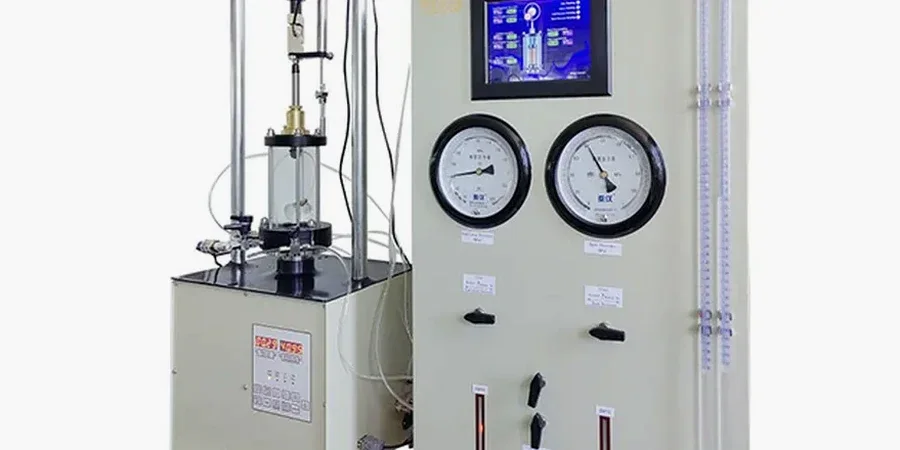
Pickering sits at an elevation of about 217 meters above sea level, with the Lake Ontario shoreline defining its southern boundary. The population has surpassed 99,000. That growth pushes infrastructure into areas with sensitive soils. Our triaxial apparatus applies confining pressures up to 1 MPa and back-pressure saturation following ASTM D4767. We measure pore water pressure during shear. This yields effective stress parameters: c' and φ'. For cohesive soils from the Northern Till plain, we run multi-stage tests to define the failure envelope from a single specimen. It saves time and reduces sample disturbance. When the project requires stiffness data, we also recommend CPT testing to calibrate the modulus with continuous profiling. Each test includes B-value checks above 0.95. We log axial strain, deviator stress, and excess pore pressure. The data feeds directly into PLAXIS or Slide models for slope stability and excavation support.
Triaxial Testing in Pickering: Shear Strength Parameters for Foundation Design
Technical reference — Pickering

Local geotechnical context

The Rouge River valley and the Lake Ontario bluffs introduce slope instability risks across Pickering. The Halton Till here can be overconsolidated. That means high peak strength but potential softening over time. If you sample the stiff clay from a depth of 8 meters and test it at low confining stress, you may overestimate the operational strength. We run tests at in-situ stress levels to avoid that trap. Seasonal groundwater fluctuations along the Frenchman's Bay area also alter pore pressure regimes. A CU test with pore pressure measurement captures that behavior. Ignoring the effective stress path leads to retaining walls that tilt and footings that settle differentially. In our experience, the most common failure we see in forensic reviews is a design based on total stress parameters that missed the long-term drained condition.

Need a geotechnical assessment?

Reply within 24h.

Email: info@geotechnicalengineering.co

Regulatory framework

ASTM D4767 – CU triaxial with pore pressure, ASTM D7181 – CD triaxial for granular soils, NBCC 2020 – seismic and foundation provisions

Typical values

ParameterTypical value
Specimen diameter50 mm (Shelby tube)
Confining pressure range50 – 800 kPa
Test typesCU, CD, UU, multi-stage
Back-pressure saturationB-value ≥ 0.95
Shear rate (CU)0.05 – 0.1 %/min
Effective friction angle (φ')Reported with Mohr-Coulomb fit
Cohesion intercept (c')kPa, from p'-q plot

Quick answers

What does a triaxial test cost in Pickering?

A standard CU triaxial test with three effective stress points typically ranges from CA$2,760 to CA$3,780. Multi-stage tests or CD tests on coarse materials may fall at the upper end of that range due to longer shearing times.

How many specimens do I need for a design?

We recommend at least three specimens from the same depth to define a reliable Mohr-Coulomb envelope. For critical infrastructure near the Pickering Nuclear Generating Station, we often run five or more to meet probabilistic design requirements.

Which test type is right for Pickering's glacial till?

For short-term stability analysis, a CU test with pore pressure measurement is standard. If you are evaluating a permanent slope or a retaining wall with a long design life, a CD test or a CU test analyzed for the drained condition is more appropriate.

How do you handle sample disturbance?

We trim specimens carefully from Shelby tubes and check the initial saturation. If disturbance is evident, we apply a reconsolidation stage to approximate the in-situ stress state before shearing. The B-value check confirms the quality of saturation.

Location and service area

We serve projects in Pickering and surrounding areas.

View larger map