GEOTECHNICALENGINEERING
PICKERING
HomeGeophysicsElectrical resistivity / VES (Vertical Electrical Sounding)

Electrical Resistivity Surveys in Pickering – VES for Soil & Groundwater Profiling

Sound ground. Sound decisions.

LEARN MORE

Pickering sits on a complex glacial landscape shaped by Lake Ontario’s ancient shoreline. The population here passed 99,000 in 2021 and keeps growing, driving foundation work into the Halton Till and glaciolacustrine deposits that define the shallow subsurface. In our lab, we see the same challenge repeat: clients need to know what’s underground before a drill rig ever shows up. That’s why we run Vertical Electrical Sounding surveys across the city. VES gives us a resistivity profile that separates sand lenses from clay layers and picks up groundwater without disturbing the soil. For projects near the Duffins Creek corridor or the nuclear station buffer zone, we often pair early-phase resistivity with a CPT program to ground-truth the geophysics once access opens up.

Resistivity contrast between the Halton Till and the underlying glaciolacustrine clays gives us a clean stratigraphic signal across Pickering.
Our service areas

Our approach and scope

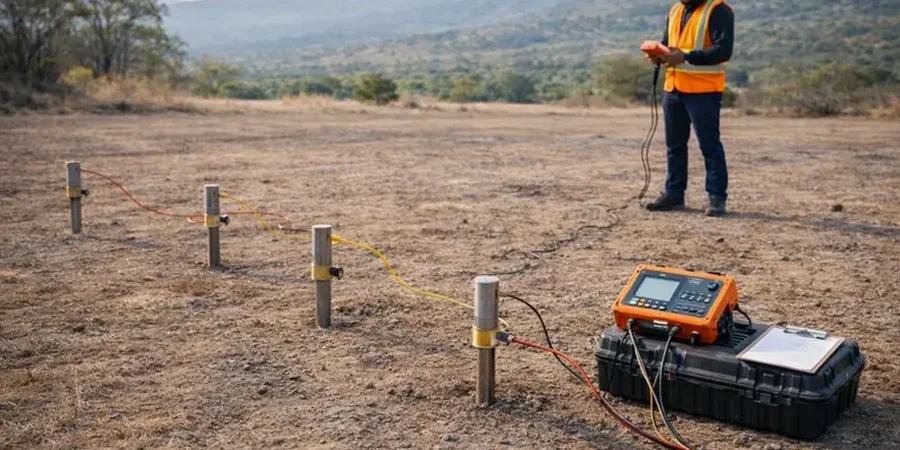
Our field protocol follows NBCC 2015 guidelines for site characterization, with electrode arrays configured to the target depth. In Pickering’s typical setting, we use Schlumberger spreads for deep vertical resolution. The till here is dense and silty. The glaciolacustrine clays are conductive. Contrast is strong and the data reads clearly when the array is sized right. We log every sounding with apparent resistivity curves and invert the data using least-squares routines to produce a layered model. The output is a geoelectric section that shows layer thickness and resistivity in ohm-m. This becomes the baseline for planning boreholes or targeting zones where the overburden is thickest. Field notes include electrode spacing, contact resistance checks, and local coordinates tied to the Pickering topographic grid.
Electrical Resistivity Surveys in Pickering – VES for Soil & Groundwater Profiling
Technical reference — Pickering

Local geotechnical context

We use a four-electrode resistivity meter with a 250 W transmitter and a high-impedance receiver. The current electrodes go into the ground with stainless steel stakes. In Pickering, the challenge is always the same: dry summer surface conditions in the upper 30 cm of topsoil. That increases contact resistance fast. We carry saturated bentonite and saline solution to improve coupling when we hit dry crust over the till. If we don’t get good injection current, the whole sounding is compromised. The other risk is cultural noise. Buried utilities, metallic fences near residential subdivisions, and the 500 kV transmission corridor that runs through Pickering all distort the electric field. We document every anomaly source we spot in the field log so it’s flagged during interpretation.

Need a geotechnical assessment?

Reply within 24h.

Email: info@geotechnicalengineering.co

Regulatory framework

NBCC 2015 – Section 4.2.4 for geotechnical site investigation requirements, CSA A23.3 – reference for concrete structures where resistivity informs corrosion risk, ASTM D6431-18 – standard guide for direct-current resistivity methods

Typical values

ParameterTypical value
Array configurationSchlumberger / Wenner
Maximum investigation depthUp to 100 m (AB/2 = 150 m)
Typical sounding time45–90 min per VES station
Measured parameterApparent resistivity (ohm-m)
Output model1D layered geoelectric section
Data inversion methodLeast-squares with smoothness constraint
Contact resistance checkEvery electrode position, recorded

Quick answers

How deep can a VES sounding reach in Pickering’s glacial soils?

We typically configure the array to reach 60 to 100 m depth. The actual penetration depends on the current injection and the resistivity contrast of the till and clay layers. In Pickering’s geology, 80 m is a realistic target for most projects.

What does a VES survey cost for a standard lot in Pickering?

For a single VES station on a residential or light commercial lot in Pickering, the cost ranges from CA$990 to CA$1,320. The final figure depends on the number of soundings, access conditions, and whether we need to add extra coupling measures for dry surface soils.

Can resistivity data replace boreholes?

No. Resistivity gives you a continuous geoelectric model, but it does not provide direct material samples. In our workflow, VES guides the borehole or CPT layout so you drill fewer holes in the right places, but you still need physical verification to meet NBCC requirements.

Location and service area

We serve projects in Pickering and surrounding areas.

View larger map