GEOTECHNICALENGINEERING
PICKERING
HomeFoundationsRaft/mat foundation design

Raft Foundation Design in Pickering: Engineered for the Duffins Creek Basin

Sound ground. Sound decisions.

LEARN MORE

Pickering sits at roughly 217 meters above sea level, but the real story is underground. The city sprawls across the Duffins Creek watershed, where glacial till, sand, and silt deposits shift every few hundred meters. A standard footing can work on the Oak Ridges Moraine, but drop south toward the lakefront, and you're into softer, wetter ground that demands a different approach. That's where a raft foundation becomes the smartest move. It spreads the structural load across a continuous slab, neutralizing differential settlement before it starts. We've seen too many projects near Frenchman's Bay where ignoring the soil variability led to cracked slabs within five years. The geology here doesn't forgive guesswork. With our technical team, you get a raft/mat foundation design that reads the land first and reacts to what it actually finds, not what a textbook assumes.

A raft foundation in Pickering isn't just a thick slab. It's a settlement-mitigation system tuned to the erratic soils of the Duffins Creek basin.
Our service areas

Our approach and scope

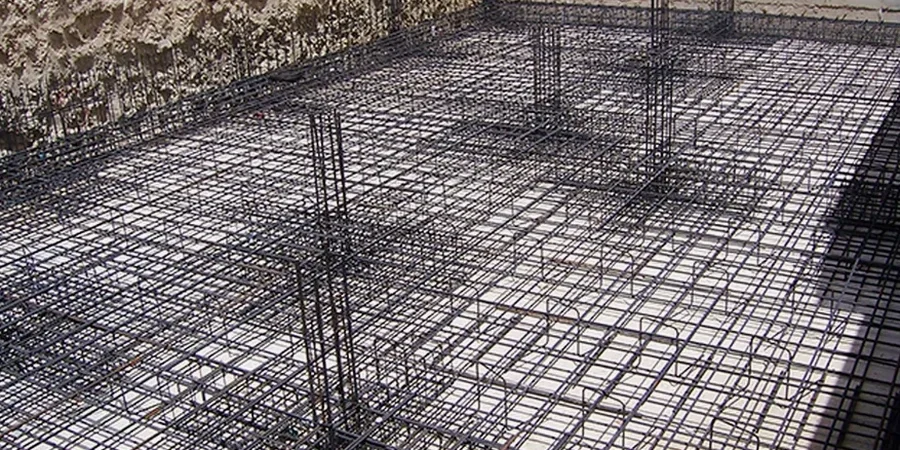
The National Building Code of Canada (NBCC 2020) and CSA A23.3 set clear performance standards, but in Pickering the ground truth is always local. Our design process starts with a detailed site investigation to map the stratigraphy. We don't just pull a bearing capacity number from a table. We correlate in-situ test pits and borehole data to define the modulus of subgrade reaction with precision, because a mat foundation here often spans lenses of loose silt left by the ancient Lake Iroquois shoreline. The slab thickness and reinforcement aren't guesses; they're calculated responses to the specific soil-structure interaction at your site. We model the raft as a flexible plate on an elastic foundation, accounting for the stiff clay pockets and the looser sandy zones that characterize much of north Pickering. The result is a design that minimizes concrete volume while maximizing long-term performance, a balance that matters when you're building on ground shaped by retreating glaciers.
Raft Foundation Design in Pickering: Engineered for the Duffins Creek Basin
Technical reference — Pickering

Local geotechnical context

The contrast between the north and south of Pickering is stark. Up near the moraine, you get dense till; you can almost hear the excavator working harder. But down by the hydro corridor south of Bayly Street, the organic silts and high groundwater become the main character in the story. The biggest risk we see is differential settlement. When half your mat sits on competent till and the other half spans an old buried stream channel, the slab wants to rotate. It's not a crack issue at first; it's a door-frame issue, a plumbing-pitch issue, a slow, expensive headache. Ignoring a detailed raft/mat foundation design here means accepting that the building will move unevenly for the next thirty years. We model these transitions aggressively. The design must bridge the soft spots without making the whole slab so rigid that it becomes cost-prohibitive. That's the local engineering challenge in a sentence.

Need a geotechnical assessment?

Reply within 24h.

Email: info@geotechnicalengineering.co

Regulatory framework

CSA A23.3: Design of Concrete Structures, NBCC 2020: National Building Code of Canada, ASTM D1194: Standard Test Method for Bearing Capacity of Soil for Static Load, CSA S6: Canadian Highway Bridge Design Code (for related transport structures)

Typical values

ParameterTypical value
Design StandardCSA A23.3, NBCC 2020
Typical Slab Thickness300 mm to 1200 mm
Subgrade Modulus (k) Range10 to 40 MPa/m
Maximum Allowable Settlement25 mm total; 20 mm differential
Reinforcement Yield Strength400 MPa to 500 MPa
Load-Bearing Capacity75 kPa to 300 kPa
Seismic CategorySite Class C to E per NBCC

Quick answers

Why choose a raft foundation over isolated footings in Pickering?

In areas with soft or variable soils, like the lakefront zones of Pickering, isolated footings can settle at different rates, causing structural distress. A raft foundation spreads the load across the entire footprint, bridging weak spots and reducing differential settlement to acceptable limits.

What is the typical cost range for a raft foundation design in Pickering?

For a standard residential or light commercial project in Pickering, the engineering design of a raft foundation typically falls between CA$1,350 and CA$4,940. The final cost depends on the slab area, soil complexity, and the level of seismic analysis required by the NBCC.

How does the Duffins Creek watershed affect my foundation?

The watershed has deposited layers of sand, silt, and organic material over time. These deposits can be highly compressible. Our design process identifies these layers early so the raft foundation can be engineered to span them without excessive long-term settlement.

Do you handle the seismic design for raft foundations?

Yes. Pickering is in a moderate seismic zone. We incorporate site-specific seismic hazard data into the design, ensuring the raft foundation meets all ductility and stability requirements of the NBCC 2020 and CSA A23.3.

Location and service area

We serve projects in Pickering and surrounding areas. More info.

View larger map