GEOTECHNICALENGINEERING
PICKERING
HomeRoadwayFlexible pavement design

Flexible Pavement Design for Pickering’s Glacial Soils

Sound ground. Sound decisions.

LEARN MORE

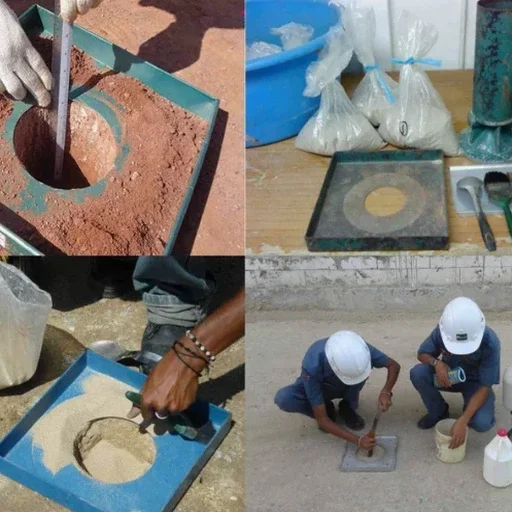
In Pickering, we often see pavement failures that start not with traffic loads but with water trapped in the granular base. The city sits on a mix of Halton Till and glaciolacustrine deposits near the Lake Ontario shoreline. These silty clays hold moisture. When freeze-thaw cycles kick in during March, the subgrade loses strength fast. A flexible pavement design has to manage that seasonal swing. We model the structure using layered elastic theory and local CBR values, not generic tables. The AASHTO 93 method gives us a starting point, but we refine it with actual soil data from the site. For projects near the Rouge River floodplain, we also check the CBR road analysis to correlate field strength with lab results before finalizing the asphalt thickness.

A pavement is only as strong as its weakest springtime subgrade condition — that’s where we focus the geotechnical investigation in Pickering.
Our service areas

Our approach and scope

Pickering’s population has grown past 100,000, pushing new subdivisions into areas underlain by compact glacial till. That till can have CBR values above 15% in summer. But in spring, the same material drops below 5% if drainage is poor. A proper flexible pavement design accounts for this seasonal modulus variation. We specify an open-graded drainage layer beneath the base course. We also require a minimum 450 mm of non-frost-susceptible granular material in areas where the water table is high. The asphalt concrete surface course is designed for the ESAL projections the City of Pickering provides. Our lab runs the full suite of tests: grain size distribution, Atterberg limits, and modified Proctor compaction. Every input ties back to a specific layer in the pavement cross-section. No guesswork.
Flexible Pavement Design for Pickering’s Glacial Soils
Technical reference — Pickering

Local geotechnical context

Pickering’s development arc from a rural township to a Durham Region node left a patchwork of fill zones. Older areas near the GO station sit on undocumented fill up to 2 meters thick. If you place a flexible pavement over that without investigation, differential settlement appears within two winters. The fill often contains bricks, wood fragments, and pockets of organic silt. That triggers localized subgrade failure. We saw this pattern on a commercial lot off Kingston Road last year. The owner had repaved twice in five years. The fix wasn’t thicker asphalt. It was subgrade stabilization with cement and a properly keyed granular base. The risk is not just rutting. It’s a pavement cross-section that looks fine on paper but fails because the subgrade modulus is an assumption, not a measured value.

Need a geotechnical assessment?

Reply within 24h.

Email: info@geotechnicalengineering.co

Regulatory framework

AASHTO Guide for Design of Pavement Structures (1993), Ontario Provincial Standard Specification (OPSS) 310, 1010, ASTM D1883 (CBR) / ASTM D1557 (Modified Proctor), CSA A23.1 Concrete Materials and Methods (for rigid tie-ins)

Typical values

ParameterTypical value
Design methodAASHTO 1993 with local calibration
Asphalt surface courseHL3 or HL4; Superpave PG 58-28 binder
Base courseGranular A, 150 mm min; CBR ≥ 80%
Sub-base courseGranular B Type II, 300–450 mm; CBR ≥ 30%
Subgrade CBR thresholdMinimum 6% after moisture conditioning
Drainage coefficient1.0 to 1.2 depending on time to drain
Reliability level85% for arterial roads, 75% for local streets
Frost protectionNon-frost-susceptible granular to frost depth (1.2 m)

Quick answers

What CBR value do you require for a flexible pavement subgrade in Pickering?

We target a minimum design CBR of 6% after moisture conditioning. In the glacial till east of Brock Road, we often see values above 10%. But near the lake, where lacustrine clays dominate, the soaked CBR can be 3–4%. When that happens, we thicken the sub-base or recommend lime stabilization to raise the effective subgrade strength before placing the granular.

How much does a flexible pavement design cost for a Pickering project?

For a typical commercial or residential access road, the investigation and design package ranges from CA$2,440 to CA$7,010. The spread depends on the number of test pits, lab CBR tests, and whether we need to model multiple cross-section alternatives. A longer road with variable subgrade conditions sits at the upper end because we sample more locations.

How do you handle the freeze-thaw cycle in the pavement design?

We calculate the frost penetration depth using the freezing index for the Pickering area. The sub-base thickness is set so that no frost-susceptible soil lies within that zone. We also specify a drainage layer that moves water out of the base course before it can freeze. The asphalt binder is a PG 58-28, which handles low-temperature cracking better than a standard PG 58-22.

Do you use the AASHTO 1993 method or the MEPDG for design?

We use AASHTO 1993 with regional calibration factors that reflect Ontario’s climate and traffic loading. The MEPDG requires more input data than most private projects have. We focus on getting the subgrade modulus right and matching the structural number to the ESAL count. That approach has proven reliable across Durham Region.

Location and service area

We serve projects in Pickering and surrounding areas.

View larger map