GEOTECHNICALENGINEERING
PICKERING

Geotechnical Engineering in Pickering

Sound ground. Sound decisions.

LEARN MORE

In Pickering, the contrast between the sandy ridges of the Lake Iroquois shoreline and the silty clay plains near the Rouge River creates radically different bearing conditions within a kilometer. You can have dense sand at three meters on a Duffin Heights lot and soft clay at twenty meters by Frenchman's Bay. That variability means a standard soil mechanics study is the only way to cut through guesswork. Our lab runs the full suite: consolidation, direct shear, and triaxial testing on Shelby tube samples pulled from your boreholes. We process specimens under controlled moisture and density, then deliver parameters you can plug straight into NBCC 2015 limit states design. For deeper profiles in the Rouge valley, we often pair the lab program with CPT testing to fill gaps between sample intervals and confirm stratigraphy without disturbing the clay structure.

Lab consolidation tests on Pickering's post-glacial clays often reveal settlement potential that standard penetration resistance alone would miss.
Geotechnical Engineering in Pickering
Technical reference — Pickering

Our service areas

Local geology

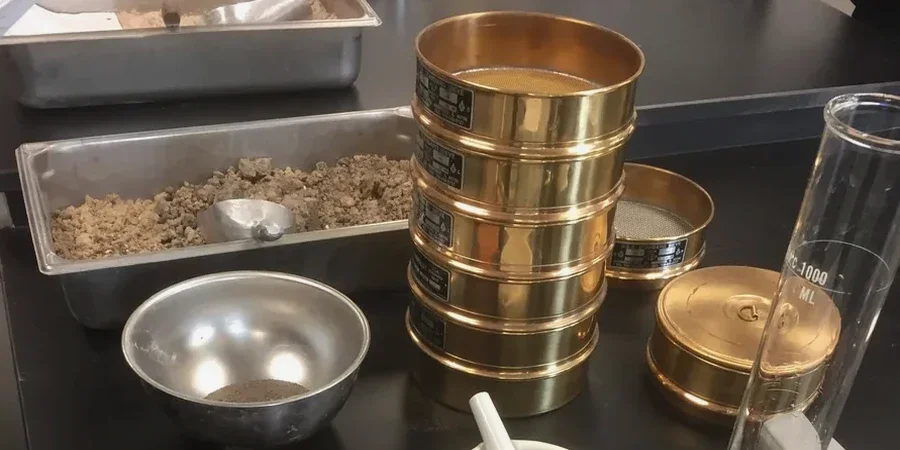
Pickering sits at roughly 43.8°N latitude, and the freeze-thaw cycle here penetrates 1.2 meters into exposed clay, which directly affects your soil mechanics study parameters. We handle that by conditioning all remolded specimens through wet-dry cycles before running Atterberg limits and unconfined compression, so the PI and shear strength values reflect the actual seasonal range, not just summer conditions. Our lab operates under ISO/IEC 17025 accreditation and reports data traceable to the Canadian national measurement system. Typical deliverables include: effective and total stress strength envelopes for short-term and long-term analysis, coefficient of consolidation from incremental loading oedometer tests, and grain-size distribution curves that classify the material per the Unified Soil Classification System. When the site geology points to liquefiable sands below the water table, we run cyclic triaxial testing and reference the Seed & Idriss framework alongside NBCC seismic provisions. We also cross-reference lab strength data with field SPT drilling records to calibrate empirical correlations against measured blow counts.

Regulatory framework

NBCC 2015 (National Building Code of Canada) – geotechnical design provisions, CSA A23.3 – Design of concrete structures, foundation requirements, ASTM D2435 – One-dimensional consolidation properties of soils, ASTM D4767 – Consolidated undrained triaxial compression test, ISO/IEC 17025 – General requirements for testing laboratory competence

Need a geotechnical assessment?

Reply within 24h.

Email: info@geotechnicalengineering.co

Why choose us

A four-storey residential building near the Pickering Town Centre sat on a layer of compressible organic silt that the preliminary auger sampling missed. The developer poured footings based on stiff clay assumptions, and within six months the northwest corner had settled 35 millimeters. We got called in after the cracks appeared. A targeted soil mechanics study on undisturbed silts showed the effective friction angle was half what the original report assumed, and the consolidation coefficient meant settlement would continue for another eighteen months. That project ended up needing deep foundation elements driven to the till at 22 meters. The lesson is local: Pickering's post-glacial deposits hide organics and soft lenses that only lab consolidation and triaxial data can quantify before concrete goes in the ground.

Typical values

ParameterTypical value
Effective friction angle (φ')28°–38° (dense sand), 18°–26° (clayey silt)
Undrained shear strength (Su)25–180 kPa (varies with OCR and depth)
Coefficient of consolidation (Cv)0.5–8.0 m²/year (soft to stiff clay)
Liquidity index range tested0.2–1.4 (sensitive post-glacial silts)
Standard: Consolidation testASTM D2435 (incremental loading)
Standard: Triaxial testASTM D4767 (CU with pore pressure)

Quick answers

How long does a full soil mechanics study take from sample drop-off to final report?

Consolidation tests run up to ten days per specimen depending on the loading increments and the clay's drainage rate. A typical suite of three triaxial and three consolidation tests, plus index testing, takes about fifteen business days. We can expedite the triaxial portion to seven days if the project schedule requires preliminary parameters for foundation sizing.

What sample quality do you need for triaxial and consolidation testing?

We need undisturbed Shelby tube samples with no visible fissures, drying, or disturbance from tube driving. The tubes should be sealed with wax immediately after extraction and transported upright. For Atterberg and sieve analysis, representative bulk samples in sealed plastic bags work fine. If the tubes arrive with signs of disturbance, we will note it in the report and may recommend conservative lower-bound parameters.

What does a soil mechanics study cost for a typical Pickering residential lot?

For a standard single-family lot requiring index testing plus two consolidation and two triaxial tests, the soil mechanics study ranges from CA$3,870 to CA$6,680, depending on the number of strata and whether cyclic testing is needed. A detailed quote follows sample inspection and a review of the borehole logs.

Can you test for liquefaction potential under the NBCC seismic provisions?

We run cyclic triaxial tests on saturated sands and silts to measure pore pressure buildup under seismic loading. The results are reported as cyclic resistance ratio curves that the design engineer can compare against the seismic demand from the NBCC 2015 hazard maps. We also run grain-size and fines content analysis, because the presence of more than 15 percent fines significantly affects liquefaction susceptibility.

Location and service area

We serve projects in Pickering and surrounding areas.

View larger map