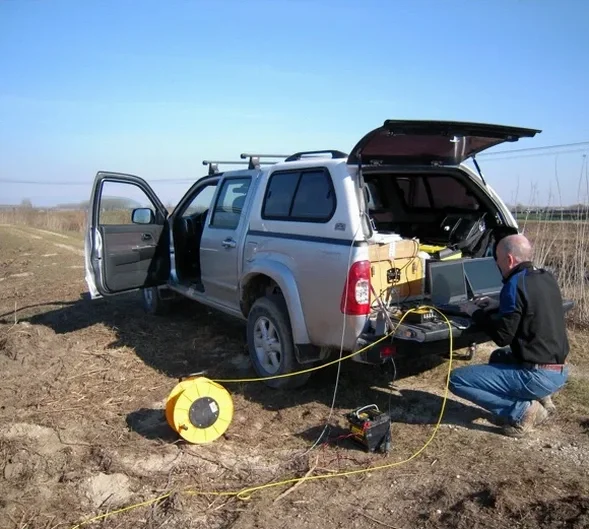
A three-storey office complex off Kingston Road hit unexpected weathered shale at 14 metres — right where the borehole log showed competent rock. The contractor lost three weeks and CA$80,000 in change orders. That scenario replays across Pickering more often than anyone admits, and it usually traces back to sparse drilling alone without geophysical cross-check. Seismic refraction and reflection tomography plug that gap: we shoot a linear geophone spread across the site, record P-wave and S-wave travel times, and invert the data into a continuous velocity cross-section that reveals lateral changes no single borehole can catch. Whether it is the glacial till overlying the Georgian Bay Formation or the buried valleys that thread through the Duffins Creek watershed, the velocity contrast between overburden and bedrock stands out sharply. We run the survey, process the picks with iterative ray-tracing, and deliver a 2D profile tied to your geotechnical grid. For deeper targets, seismic refraction handles 30–60 m penetration with a 120 m spread, while reflection mode reaches beyond 100 m when the site geometry allows it.
A velocity cross-section calibrated with just two boreholes can resolve bedrock topography across a 200-metre transect within half a metre.