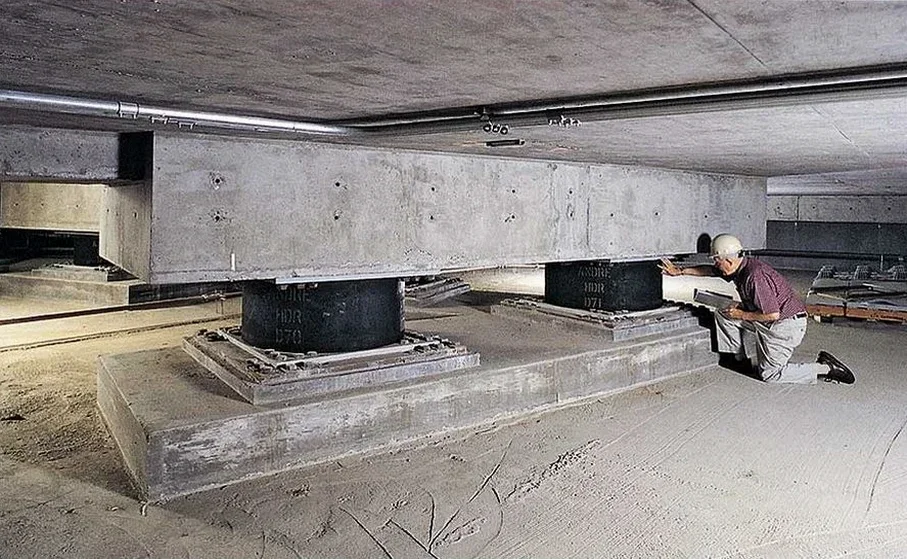
The Rouge River watershed carves through Pickering, leaving behind a patchwork of glacial till, sand plains, and sensitive clay deposits that don't exactly whisper stability during a seismic event. When you're engineering a critical facility a few kilometers from the Lake Ontario shoreline, the conversation shifts from 'if' to 'how much' ground motion the structure can actually take before performance degrades. Base isolation seismic design flips that script—instead of bracing a building to fight the earthquake, you decouple it from the ground entirely. Our team has been deep in the geotechnical data around the Duffin Heights and Liverpool Road corridors, and the numbers are clear: a well-tuned isolation system cuts spectral acceleration demands by up to 60% compared to fixed-base assumptions in the Pickering area. That's not a design margin, that's a different philosophy altogether. The 2013 Ladysmith earthquake in Quebec reminded everyone in southern Ontario that intraplate seismicity isn't theoretical, and for a community anchored by the Pickering Nuclear Generating Station, resilience starts at the foundation level. Many projects in the region benefit from pairing isolation analysis with a detailed seismic microzonation study to capture site-specific amplification effects that the generic NBCC hazard maps can't resolve.
Decoupling a structure from the ground in Pickering isn't just about isolators—it's about understanding how the Rouge Valley's till-over-shale stratigraphy amplifies long-period motion before it ever reaches the foundation.