GEOTECHNICALENGINEERING
PICKERING
HomeFoundationsShallow foundation design

Shallow Foundation Design in Pickering: Site-Specific Geotechnical Solutions

Sound ground. Sound decisions.

LEARN MORE

Pickering's subsurface landscape tells a story written by glacial Lake Iroquois. The city sits predominantly on a plain of dense, silty clay till overlying the Georgian Bay shale formation, a deposit that can vary from stiff to very stiff within a single building footprint. Groundwater often perches within sand and silt lenses at depths of 2 to 5 meters, particularly in neighborhoods east of the Rouge River valley. For any project here, from a residential addition near Frenchman's Bay to a commercial structure along Brock Road, shallow foundation design must reconcile the moderate bearing capacity of these glacially overconsolidated soils with the seismic demands of the Southern Great Lakes seismic zone. A site-specific investigation that includes test pits to visually log the upper weathered crust is the essential first step before any footing geometry is finalized.

In Pickering's Lake Iroquois plain, the difference between a successful shallow foundation and a costly repair lies in mapping the buried sand lenses that control both drainage and differential settlement.
Our service areas

Our approach and scope

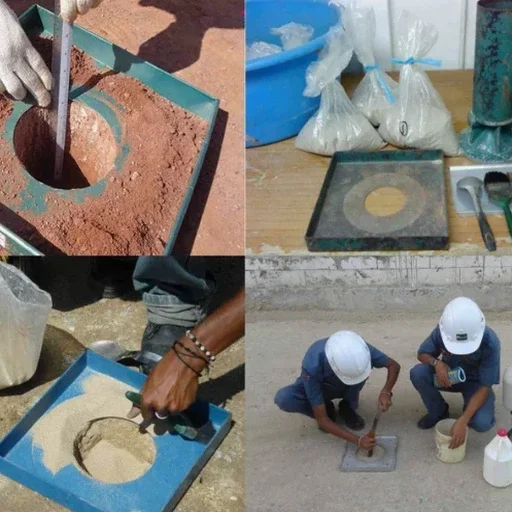
Consider a recent two-storey commercial building proposed just north of Highway 401. The preliminary site investigation revealed a buried swale filled with organic silt and soft clay, directly beneath what the developer had planned as a continuous strip footing. By integrating our design with an in-situ permeability test to quantify drainage characteristics, we recommended excavating the compressible material and replacing it with engineered, compacted granular fill. This avoided the differential settlement that would have cracked the slab-on-grade within the first three freeze-thaw cycles. The final shallow foundation design utilized widened, steel-reinforced footings bearing on the competent till, distributing column loads efficiently across the variable stratigraphy. For larger-footprint structures where discrete footings become uneconomical, we often transition to a mat foundation approach, using finite element settlement analysis to model the interaction between the rigid slab and the underlying soil matrix.
Shallow Foundation Design in Pickering: Site-Specific Geotechnical Solutions
Technical reference — Pickering

Local geotechnical context

Pickering's climate presents a particular challenge for shallow foundations that designers from milder regions often underestimate. The city endures intense freeze-thaw action each winter, with frost penetration reaching depths that can heave inadequately embedded footings. Equally serious is the seasonal swelling potential of the near-surface weathered till, which can exert uplift pressures on lightly loaded slabs if positive drainage is not meticulously detailed. Overlooking the presence of isolated sand pockets within the till matrix carries its own peril; these lenses can act as conduits for groundwater, creating localized softened zones under load. A foundation system that neglects to specify a capillary break layer of clean, free-draining stone beneath the slab risks chronic moisture intrusion into the structure, promoting mold growth and degrading floor finishes over time.

Need a geotechnical assessment?

Reply within 24h.

Email: info@geotechnicalengineering.co

Regulatory framework

NBCC 2020 (National Building Code of Canada) – Part 4 Structural Design, CSA A23.3-19 – Design of Concrete Structures, ASTM D1194 / D1194M – Standard Test Method for Bearing Capacity of Soil for Static Load and Spread Footings, CSA S6:19 – Canadian Highway Bridge Design Code (for related infrastructure projects)

Typical values

ParameterTypical value
Typical Bearing Capacity (Stiff Clay Till)150 - 300 kPa (Ultimate)
Design StandardNBCC 2020, CSA A23.3-19
Minimum Footing Depth (Frost Protection)1.2 m below finished grade
Seismic Site Class (Typical)Class C or D per NBCC Table 4.1.8.4.A
Allowable Settlement (Total/Differential)25 mm / 20 mm (Conventional structures)
Construction ConsiderationSubgrade must be proof-rolled and protected from moisture
Typical Groundwater Depth2.0 m to 5.0 m below surface (seasonally variable)

Quick answers

What is the typical cost range for a shallow foundation design package for a single-family home in Pickering?

For a standard residential shallow foundation design in Pickering, including a site investigation review, bearing capacity assessment, and stamped design drawings for strip or pad footings, the engineering fee typically falls between CA$2,330 and CA$3,950. The final cost depends on the complexity of the soil conditions, the number of footing types required, and the level of construction review requested.

How do Pickering's clay till soils affect the choice between a shallow foundation and a deep pile system?

The stiff to very stiff clay till in Pickering generally offers excellent bearing capacity for shallow foundations for low to mid-rise structures. A shallow system becomes feasible when the allowable settlement can be kept within tolerable limits and the load-induced stress bulb does not intersect a deep, compressible layer. We typically switch to a deep foundation system only when the structural loads are exceptionally heavy, when the till is underlain by soft shale at a shallow depth, or when deep excavations would be required anyway.

What depth of footing is required to meet Pickering's frost protection requirements?

Per the Ontario Building Code, which references the NBCC, the minimum depth of foundation in Pickering must be at least 1.2 meters below finished grade to protect against frost heave. However, this depth may need to be increased if the geotechnical investigation reveals frost-susceptible silt lenses, organic soils, or if the footing bears on a slope where lateral frost action could be a factor.

Can a shallow foundation be designed on the fill soils commonly found near the Lake Ontario waterfront in Pickering?

Designing a shallow foundation on uncontrolled fill is inherently risky and generally not recommended. Near the waterfront, old fill deposits can contain rubble, organic debris, and loose materials with highly variable compaction. If removal and replacement with engineered fill is not practical, we typically recommend extending the foundation through the fill to competent native till via deepened footings, or switching to a deep foundation solution such as driven steel piles socketed into the underlying shale.

Location and service area

We serve projects in Pickering and surrounding areas.

View larger map