GEOTECHNICALENGINEERING
PICKERING
HomeUnderground ExcavationsGeotechnical design of deep excavations

Geotechnical Design for Deep Excavations in Pickering

Sound ground. Sound decisions.

LEARN MORE

Pickering sits on a complex glacial stratigraphy — primarily the dense, silty-clay Halton Till overlying the deep Thorncliffe Formation. Groundwater can appear as a perched table within the till, often just 3 to 5 meters below grade. The city's proximity to the Duffins Creek watershed means pore pressures shift seasonally, and a dry cut in August can be wet in November. This makes the geotechnical design of deep excavations here a task that demands more than a generic shoring schedule. It requires a hydrogeological read of the site before the first bucket hits the ground. For projects near the Pickering Nuclear Generating Station, we often integrate seismic refraction profiles to map bedrock depth without disturbing sensitive adjacent zones.

In Pickering's Halton Till, jointing and perched water control the excavation design, not just the undrained shear strength.
Our service areas

Our approach and scope

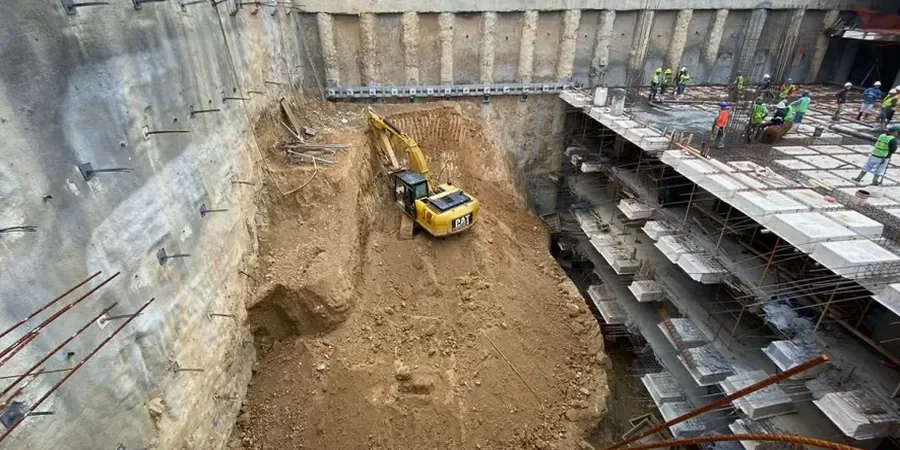
Pickering's growth from a rural township into a suburban node with high-density Seaton developments has pushed excavation depths well past 6 meters. The old farm lots are now townhouse blocks and mid-rise condos with underground parking. The dense Halton Till looks competent but reveals vertical jointing when exposed — a detail that changes lateral earth pressure assumptions overnight. For urban sites with zero-lot-line constraints, we combine the geotechnical design of deep excavations with excavation monitoring programs that track inclinometer and settlement data in real time, feeding it back into the observational method. This isn't textbook engineering; it's a continuous loop of prediction, measurement, and adjustment driven by the till's actual behavior.
Geotechnical Design for Deep Excavations in Pickering
Technical reference — Pickering

Local geotechnical context

A practical observation from local service: in Pickering, many developers treat the Halton Till as impermeable — until the first rain hits an open cut and water seeps through hairline joints, softening the face. The real risk isn't total collapse; it's progressive sloughing that undercuts adjacent footings. Basal heave is another silent threat when the excavation penetrates the till and approaches the pressurized Thorncliffe aquifer. A quick-and-dirty design ignores the till's fracture permeability and the seasonal water table rise. Proper geotechnical design of deep excavations here means designing the dewatering and the shoring as one coupled system, not two separate trades. We apply the observational method per NBCC requirements, verifying pore pressure assumptions with standpipe piezometers installed before bulk excavation begins.

Need a geotechnical assessment?

Reply within 24h.

Email: info@geotechnicalengineering.co

Regulatory framework

NBCC 2020 (Division B, Part 4), CSA A23.3:19 (Design of concrete structures), CSA S16:19 (Limit states design of steel structures), ASTM D2487 (Unified Soil Classification System), OPSS 206 (Ontario Provincial Standard for excavation and backfill)

Typical values

ParameterTypical value
Typical soil unitHalton Till (silty-clay to sandy-silt)
Unconfined compressive strength (qu)100–400 kPa (weathered to intact)
Perched water table depth2.5–5.0 m below grade
Design groundwater for basal stabilityHydrostatic head from lower aquifer (Thorncliffe Fm.)
Minimum design surcharge (urban sites)12 kPa (per NBCC live load)
Typical excavation depth range6.0–12.0 m (single/two-level parking)
Seismic hazard (Sa 0.2s)0.32g (Pickering site class D per NBCC 2020)

Quick answers

What is the typical cost range for designing a deep excavation in Pickering?

For a standard 6 to 10-meter deep urban excavation in Pickering, the geotechnical design fee typically ranges from CA$2,560 to CA$10,460. The exact cost depends on the shoring type (soldier pile vs. secant), the number of design stages, and whether a full instrumentation plan is required.

How does the Halton Till affect the choice of shoring system?

The Halton Till can be deceptively competent. Its jointed nature means it can stand vertically for short periods but is prone to block falls when pore pressures rise. We often specify soldier pile and lagging with continuous face support, or soil nails with shotcrete facing, to manage these localized instabilities.

Do you handle the dewatering design separately from the structural shoring?

The reference range for this service in Pickering is CA$2.560 - CA$10.460. The final price depends on the project scope and volume.

Location and service area

We serve projects in Pickering and surrounding areas.

View larger map