GEOTECHNICALENGINEERING
PICKERING
HomeSeismicSoil liquefaction analysis

Soil Liquefaction Analysis in Pickering — Seismic Ground Performance

Sound ground. Sound decisions.

LEARN MORE

Under Part 4 of the Ontario Building Code (OBC) and the National Building Code of Canada (NBCC 2020), seismic site classification is mandatory for most structures, and in Pickering the geology makes liquefaction screening non-negotiable. The city sits above the Queenston Shale but its surface is draped with glaciolacustrine silts, sand lenses, and recent alluvial deposits along the Rouge River and Petticoat Creek corridors. These loose water-saturated granular layers, when subjected to the ground accelerations expected in a moderate to large earthquake originating from the western Lake Ontario seismic zone, can lose strength abruptly. Our field practice in Pickering involves running SPT-based liquefaction triggering analyses (Youd et al. 2001, and updated Boulanger & Idriss 2014 procedures) followed by post-triggering settlement and lateral spreading displacement estimates. The MASW seismic survey is often deployed first to map Vs profiles and identify soft zones without extensive drilling, and when refusal depths are uncertain we add CPT testing for continuous tip resistance and pore pressure data.

In Pickering, the difference between a code-minimum screening and a site-specific CRR curve from cyclic triaxial can mean the difference between stone columns and a conventional raft.
Our service areas

Our approach and scope

A recent project on Sandy Beach Road involved a four-storey condominium where pre-construction borings hit loose sand seams at 3.8 m depth with groundwater at 1.2 m — a classic setup for cyclic mobility under the design earthquake. The team had to go beyond the standard screening chart. We extracted undisturbed Shelby tube samples and ran cyclic triaxial tests at the University of Toronto's geotechnical lab to calibrate the site-specific CRR curve, rather than relying solely on SPT blow count correlations. This approach reduced the factor of safety uncertainty enough to justify a densification program instead of deep foundations, saving the developer close to 18 percent on the foundation package. Pickering's subdivision developments east of Brock Road frequently encounter similar conditions where the Iroquois shoreline deposits cap a complex till sequence. The analysis workflow for these sites integrates laboratory index testing —
  • Atterberg limits to confirm the fines content and plasticity of the matrix
  • grain size distribution by sieve and hydrometer to classify the liquefiable layer
— before running the simplified procedure. All testing follows CSA A23.3 and ASTM D2487 for soil classification.
Soil Liquefaction Analysis in Pickering — Seismic Ground Performance
Technical reference — Pickering

Local geotechnical context

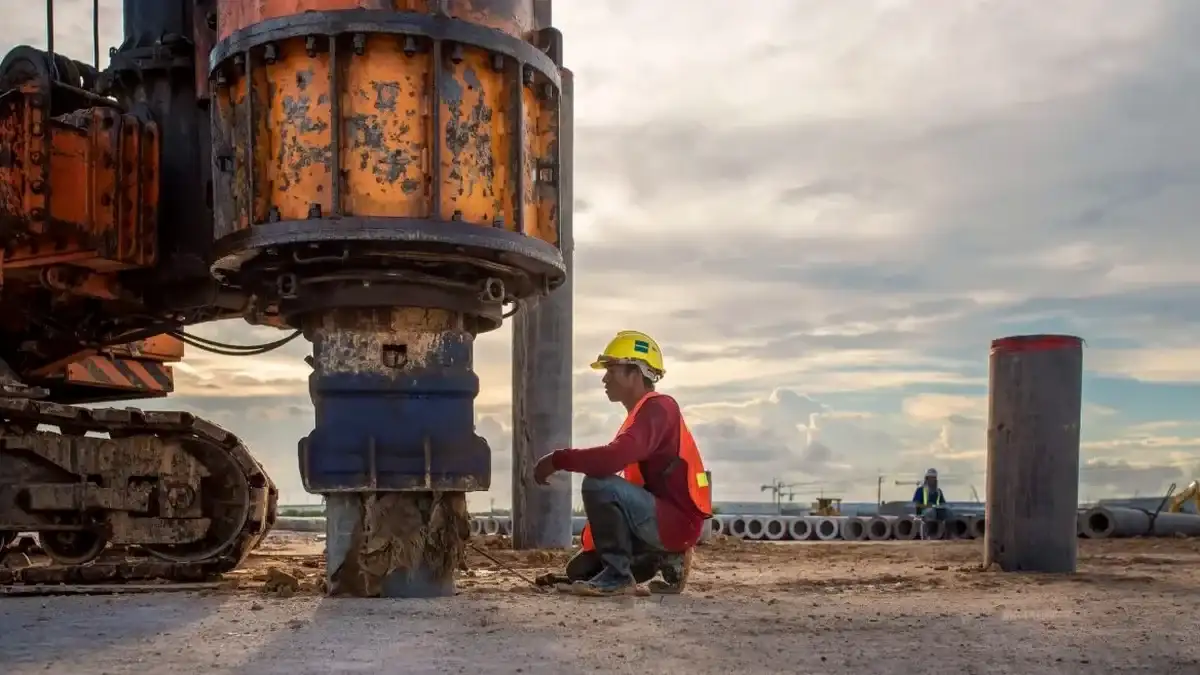
The biggest oversight we see in Pickering is treating the entire site as Site Class C or D without verifying whether loose sand pockets exist below the stiff upper crust. A site near Finch Avenue had a uniform clay profile to 12 m, so the structural engineer assumed no liquefaction risk — but a single SPT refusal at 14.5 m in a thin sand lens with N₁₆₀ = 6 changed the assessment entirely. That lens, fully saturated and unconsolidated, triggered a redistribution of shear stress that compromised the floor slab performance criteria. Another recurring issue is ignoring the influence of the Rouge River's seasonal water level fluctuations on the phreatic surface; a springtime investigation may show a much higher groundwater table than a late-summer campaign, directly affecting the cyclic stress ratio (CSR) calculation. When densification is required, we often specify stone columns installed by wet top-feed method to treat depths up to 10 m without pre-drilling, and for shallower zones vibrocompaction can achieve the target relative density with fewer passes.

Need a geotechnical assessment?

Reply within 24h.

Email: info@geotechnicalengineering.co

Regulatory framework

NBCC 2020 — Seismic Hazard Values and Site Classification (Table 4.1.8.4.A), OBC Part 4 — Structural Design, Division B, Section 4.1.8, CSA A23.3 — Design of Concrete Structures (seismic provisions), ASTM D1586 — Standard Test Method for SPT and Split-Barrel Sampling, ASTM D5311 — Standard Test Method for Load Controlled Cyclic Triaxial Strength of Soil

Typical values

ParameterTypical value
Design earthquake magnitude (M)7.0 (western Lake Ontario scenario, NBCC 2020 for Pickering)
Peak ground acceleration (PGA)0.12–0.16 g for Site Class C, 2% in 50 years probability
Liquefaction triggering methodBoulanger & Idriss (2014) — CPT and SPT-based
Post-liquefaction settlementZhang et al. (2002) and Ishihara & Yoshimine (1992) methods
Lateral spreading displacementEmpirical (Youd et al. 2002) or Newmark sliding block
Minimum Factor of Safety (FS)1.2 for low-rise, 1.5 for essential facilities (OBC Table 4.1.8.18)
Cyclic triaxial standardASTM D5311 — load-controlled, isotropically consolidated

Quick answers

Is liquefaction analysis mandatory for small residential projects in Pickering?

Under OBC Part 4, any project classified as a building requires a site classification and geotechnical investigation. For single-family homes with a ground floor area under 600 m², a simplified screening may suffice, but if the borehole log reveals loose sand below the water table, a liquefaction trigger analysis becomes part of the engineer's duty of care. We have performed these on custom homes along the Rouge valley bluffs where soft sand pockets were encountered at shallow depth.

What is the difference between SPT and CPT for liquefaction assessment?

SPT provides a disturbed sample and blow count (N-value) at discrete 1.5 m intervals, which is the traditional data for the simplified procedure. CPT provides continuous tip resistance (qc) and sleeve friction (fs) plus pore pressure (u2), giving a much finer stratigraphic profile. In Pickering's interlayered glaciolacustrine deposits, CPT can detect thin sand seams that SPT might miss, and the Robertson (2009) method directly computes the soil behavior type and CRR without needing sample recovery.

How much does a liquefaction analysis cost in Pickering?

A complete liquefaction assessment in Pickering usually ranges from CA$3,120 to CA$6,010, depending on the number of boreholes or CPT soundings, the depth of investigation, and whether cyclic triaxial testing is required. Basic SPT-based screening with two boreholes and a report will be at the lower end; adding a CPT campaign and laboratory cyclic testing moves toward the upper range.

How long does a liquefaction study take from start to finish?

Fieldwork — drilling or CPT sounding — typically takes one to two days depending on access and depth. Laboratory testing, if cyclic triaxial is specified, adds 10 to 14 working days due to specimen preparation and consolidation. The interpretive report with recommendations is delivered within three weeks of field completion in most cases.

Can liquefaction be mitigated without deep foundations?

Yes. Depending on the depth and thickness of the liquefiable layer, ground improvement methods such as vibrocompaction, stone columns, or deep dynamic compaction can densify the sand and increase the CRR above the demand. We have designed stone column grids for Pickering subdivisions where the alternative was an expensive piled raft, and the densification approach met the OBC performance criteria with a factor of safety above 1.5.

Location and service area

We serve projects in Pickering and surrounding areas.

View larger map